Closure of Public Limited Company

The dissolution of a public limited company is a highly regulated statutory process involving complex compliance with the Office of the Company Registrar (OCR) and the Securities Board of Nepal (SEBON). A formal closure is the only legal mechanism to settle public liabilities and protect the directors from personal accountability. 

 150,000.00

Introduction: Public Company Closure

Under the Companies Act, 2063, the closure of a public company—especially those with public shareholders or listed on the stock exchange—requires a transparent and rigorous liquidation process. Unlike private entities, public company closure must prioritize the protection of public investment and the systematic settlement of large-scale creditor claims, ensuring that every legal safeguard is met before the entity is struck from the national register.

Legal Requirements: Compliance Under the Companies Act, 2063

Pursuant to Chapter 10 (Liquidation) of the Companies Act, 2063, a public company can only initiate closure through a Special Resolution passed by a 75% majority at a General Meeting. The Board of Directors must first issue a Declaration of Solvency supported by an audited statement of affairs, proving the company can meet all liabilities. Due to the public nature of the entity, a licensed Liquidator must be appointed to take control of all management powers, and for listed companies, additional approvals and notifications must be coordinated with SEBON and the Nepal Stock Exchange (NEPSE) to ensure market compliance.

Failure to follow these stringent procedures results in severe legal exposure under Sections 160 and 161. The directors may face personal liability for mismanagement if the company is simply abandoned. Furthermore, the OCR imposes massive progressive fines for non-filing, and the company’s inability to clear its status will result in a permanent bar on the directors from holding similar positions in other public institutions. The Inland Revenue Department (IRD) also remains authorized to freeze the personal assets of responsible officers if corporate tax dues are left unsettled without a formal liquidation audit.

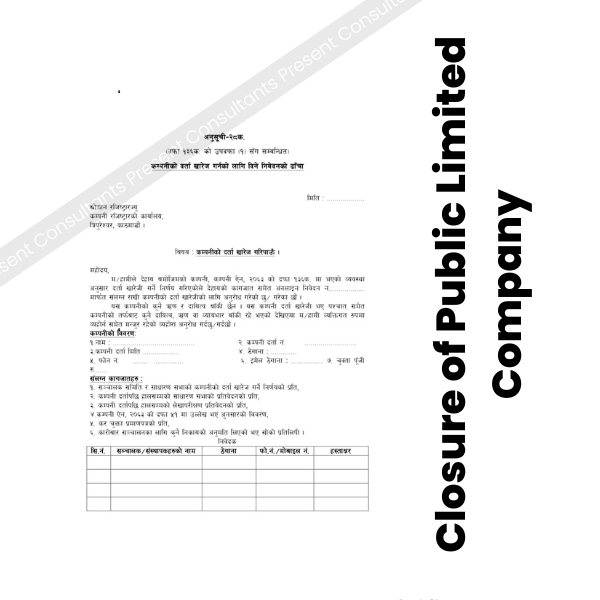
Process: Closure of Public Limited Company

Special Resolution & Regulatory Notice
Pass a Special Resolution at the Annual or Extraordinary General Meeting and notify the OCR and relevant sectoral regulators (e.g., SEBON/NRB) within the statutory timeframe.
Liquidation Advertisement & Creditor Call
Publish a formal notice of liquidation in a national daily newspaper for two consecutive weeks, inviting creditors to submit their claims within 30 days.
Asset Realization & Tax Clearance
The Liquidator settles all statutory dues, employee benefits, and public liabilities, followed by a final audit to secure a Tax Clearance Certificate from the IRD.
Final Meeting & OCR Dissolution
Conduct a final general meeting to present the liquidator’s report, distribute remaining assets, and submit the dissolution application to the OCR for the final certificate.
Ready to navigate a Public Company Exit?
Closing a public entity involves high-stakes regulatory scrutiny and extensive technical documentation. Present Consultants Private Limited provides the specialized legal and financial expertise required to manage public liquidations, ensuring your board meets all statutory duties while protecting shareholder interests.
Contact us today to manage your public company’s dissolution with professional integrity and legal precision.

Related Services