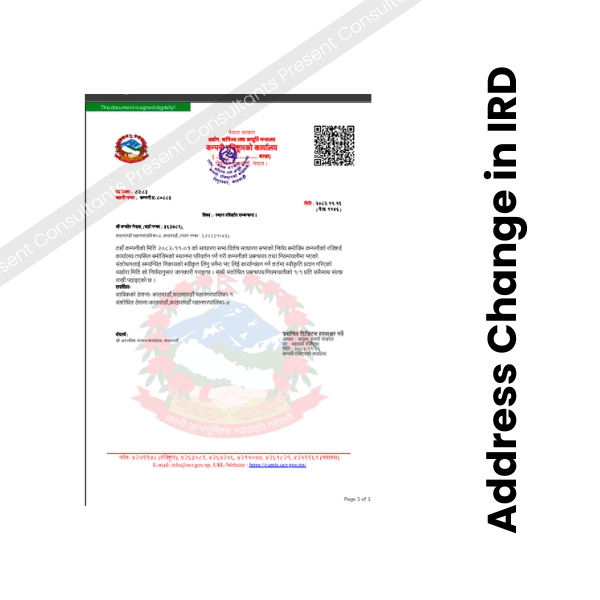
Pursuant to the Income Tax Act, 2058, a registered taxpayer is legally mandated to update and maintain accurate registration details, including geographical location, within the central biometric and administrative tax system. Any change in the business address modifies the jurisdiction of the tax administration, which must be systematically updated to ensure that tax invoices, statutory filings, and business communication remain valid. Furthermore, under Section 81 (Obligation to Maintain Records), your books of account must explicitly state the correct place of business. Rule 24 and 25 of the Income Tax Rules mandates the update of correct address.
Failure to notify the IRD of an address change within the prescribed statutory timeline constitutes an administrative violation under the Act. Pursuant to Section 119Ka of the Income Tax Act, 2058, non-compliance with the procedures and duties specified under the Act or its Rules results in a fine ranging from Rs. 5,000 to Rs. 25,000. Additionally, maintaining an incorrect address can lead to the systemic rejection of input VAT credit claims, errors in Tax Deduction at Source (TDS) filings under Section 90, and a failure to receive official tax assessments or notices under Section 102, potentially resulting in ex-parte (unilateral) tax liabilities.