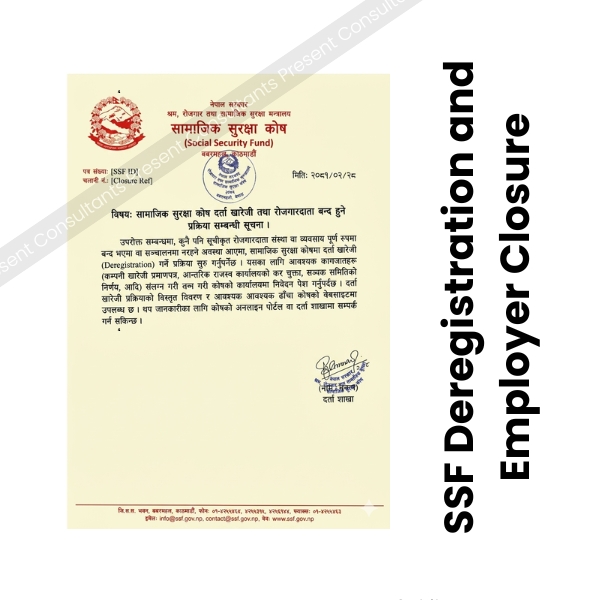
SSF Deregistration and Employer Closure (सामाजिक सुरक्षा कोष दर्ता खारेजी)

Deregistration from the Social Security Fund (SSF) is the legal process of closing an employer’s account and terminating the active contribution status of its employees. Under the Contribution-based Social Security Act, 2074, a formal exit is mandatory when a company ceases operations to stop the accrual of 31% monthly contribution liabilities and to allow employees to claim their final settlement.

 5,000.00

Introduction: SSF Deregistration & Closure

The Social Security Fund is a mandatory three-party system where the relationship between the employer, employee, and the State is codified. When a business closes, the employer remains legally responsible for the 31% monthly contribution (20% employer and 11% employee) until a formal Notice of Cessation is processed. Deregistration ensures that the employer’s “SOSYS” portal is deactivated, preventing future financial claims and allowing workers to either transfer their funds to a new employer or withdraw their accumulated savings. 

Legal Requirements: Compliance Under the Social Security Act, 2074

Pursuant to Section 24 of the Contribution-based Social Security Act, 2074, an employer is legally mandated to notify the Fund within one month of the termination of an employment relationship or the closure of the business. This notification is the trigger for the Fund to stop assessing monthly dues. A critical legal mandate involves the Settlement of Arrears. Under Section 9, if a company closes without clearing outstanding contributions, the SSF is authorized to recover the amount with a 10% interest penalty. The law treats these contributions as “priority debt,” meaning they must be settled before shareholders can distribute any remaining assets from the company’s liquidation. 

Failure to formalize SSF deregistration may lead to severe enforcement actions under the Act. If a business stops functioning, fails to notify the Fund, and fails to pay the required amount, the SSF can request the government to freeze the bank accounts and movable/immovable properties of the directors. Furthermore, the Office of the Company Registrar (OCR) and the Inland Revenue Department (IRD) often require an “SSF Clearance” or proof of employee termination before finalizing the company’s legal dissolution. Without formal deregistration, the proprietor remains personally liable for the workers’ social security benefits, including medical and accident insurance claims that may arise during the “limbo” period after the business has stopped but before the license is canceled. 

Process: SSF Exit & Settlement Steps

Termination of Employment
Log into the SOSYS Employer Portal and update the status of all employees to “Terminated.” Each termination must be supported by a resignation letter or a board minute citing the business closure.
Submission of Final Contributions
Generate the final Electronic Contribution Voucher (ECV) and clear all outstanding dues up to the last day of operation. Ensure that the 1% Social Security Tax is also reconciled.
Formal Application for Deregistration
Submit a formal written application to the SSF Office along with the Tax Clearance Certificate and the OCR Liquidation/Deregistration Notice to request permanent closure of the Employer ID.
Employee Fund Disbursement
Coordinate with employees to ensure they can access the Contributor Portal for fund withdrawal or transfer. For those with less than 15 years of service, the Fund allows a lump sum withdrawal of the total contribution plus returns upon proof of company closure.
Ready to finalize your [SSF Closure]?
Deregistration from the SSF is not just a digital task; it is a legal discharge of your fiduciary duty toward your employees. Present Consultants Private Limited manages the reconciliation of your SOSYS portal and handles the coordination with the SSF office to ensure your directors are protected from interest penalties and asset freezes.
Contact us today to manage your SSF deregistration and ensure a clean legal exit.

Related Services