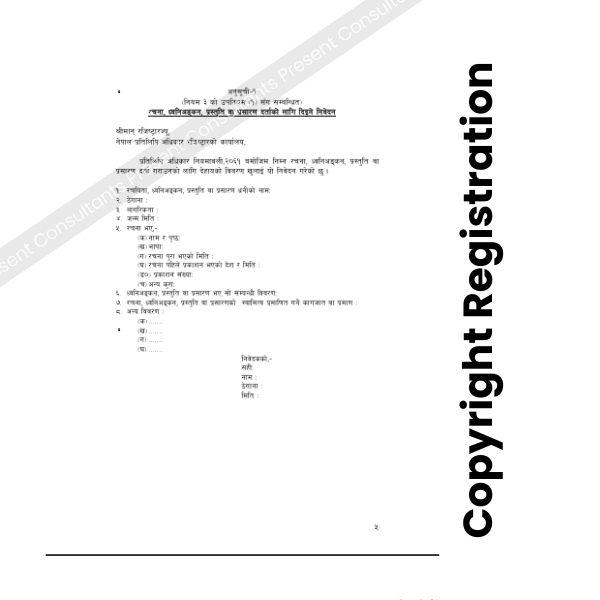
Under section 5 of the Copyright Act, 2059, registration is not mandatory for protection of any copyrightable literary/artistic work; however, registration is solid proof of ownership that grants an advantage in any litigation or issue. Section 15 of the Copyright Act, 2059, provides copyright protection for the lifetime of the author plus 50 years (single author). To qualify for Copyright Registration, the work must be original, fixed in a material form, and be copyrightable.
According to section 25 of the act, the unauthorized use, sale, reproduction, or distribution of another’s work is viewed as infringement of protected copyright. Thus, it becomes important to formally obtain copyright over any material that is being used, sold, reproduced, or distributed. According to section 27 of the Act, copyright infringement is a state-prosecuted criminal case carrying punishment of imprisonment up to six months and fines ranging from Rs. 10,000/- to Rs. 1,00,000/- for the first time, then it subsequently increases each time infringement occurs. Registration is needed because a certificate significantly lowers the burden of proof in court, enabling the owner to seek statutory damages and immediate injunctions against pirates more effectively than relying on “automatic” rights alone.