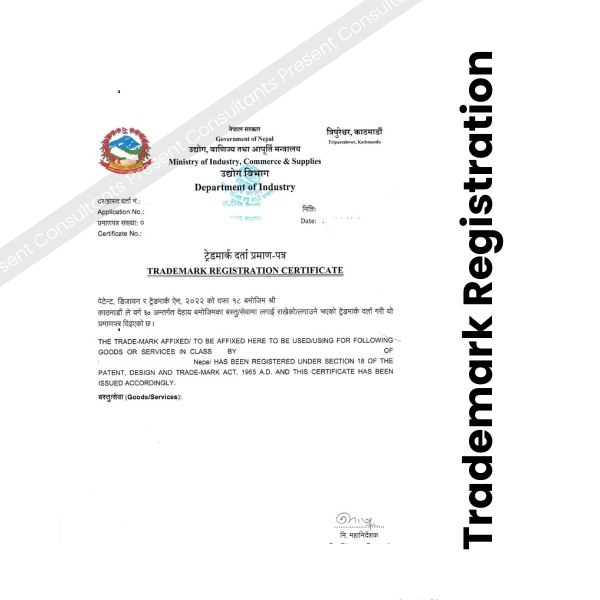
Trademark Registration (ट्रेडमार्क दर्ता)

Trademark Registration in Nepal is the only legal method to secure exclusive ownership over a brand’s identity, its name, logo, or slogan. Under the Patent, Design and Trademark Act, 2022, registration grants a business the sole right to use the mark in the marketplace, providing a powerful shield against counterfeiters and preventing competitors from “passing off” their goods as yours. 

 25,000.00

Introduction

A trademark is a word, symbol, or picture or combination to be used any brand/business to distinguish it from others. Trademark Registration is the process of officially recording as trademark as their own. In the Nepal, the Department of Industry (DOI) serves as the central authority for Trademark Registration. Nepal strictly follows a “First-to-File” system, meaning the law prioritizes the party that applies for the trademark first, rather than the party that used it first in business. Without Trademark Registration, even an established brand remains a “public asset” that any competitor can legally claim and register, potentially forcing the original creator to rebrand or face infringement lawsuits.

Legal Requirements under PTA Act: [Trademark Registration Compliance]

Pursuant to Section 16, 17, and 18 of the Patent, Design and Trademark Act, 2022, legal title to a mark is only acquired through formal registration. Applicants must submit a prescribed application along with four specimens of the trademark and proof of business registration (OCR/VAT). The Act requires that the mark be distinctive and not “deceptively similar” to existing ones. Furthermore, Nepal utilizes the Nice Classification (Classes 1–45), and protection is strictly limited to the specific classes for which the Trademark Registration is granted.

The consequences of failing to complete Trademark Registration are severe. Under Section 19, the unauthorized use of a mark that mirrors a registered trademark results in a fine of up to NPR 100,000 and the confiscation of all associated goods. Registration is a mechanical necessity because, without a certificate, you have no legal standing to file for an injunction or claim damages in court. Under section 18B no trademark may be used as a registered trade mark without registering it at the Department. Additionally according to Section 18C, if a registered mark is not brought into use within one year, the Department may cancel the registration, emphasizing that the law protects active, registered brands.

Process: The Path to Trademark Registration

Search & Preliminary Screening
Conducting a thorough database search at the DOI to ensure the mark is available and does not conflict with prior Trademark Registration filings.
Application Filing & Examination
Submitting the application to the DOI along with 4 specimens of trademark. The Department conducts a “Substantive Examination” to verify the mark’s distinctiveness and compliance with public morality.
Public Notice & 90-Day Opposition
Once accepted, the mark is published in the Industrial Property Bulletin. This triggers a mandatory 90-day opposition window where any third party can challenge the registration.
Certification & 7-Year Renewal
If no opposition is filed, the DOI issues the Trademark Registration Certificate. The mark is valid for 7 years and must be renewed indefinitely in 7-year increments to maintain protection.
Ready to Secure Your Brand?
In a “First-to-File” jurisdiction like Nepal, any delay in Trademark Registration is a risk to your business survival. Present Consultants Private Limited specializes in navigating the DOI’s examination process and managing the 90-day opposition window to ensure your brand is fully protected. Contact us today to initiate your Trademark Registration and safeguard your corporate identity.

Related Services