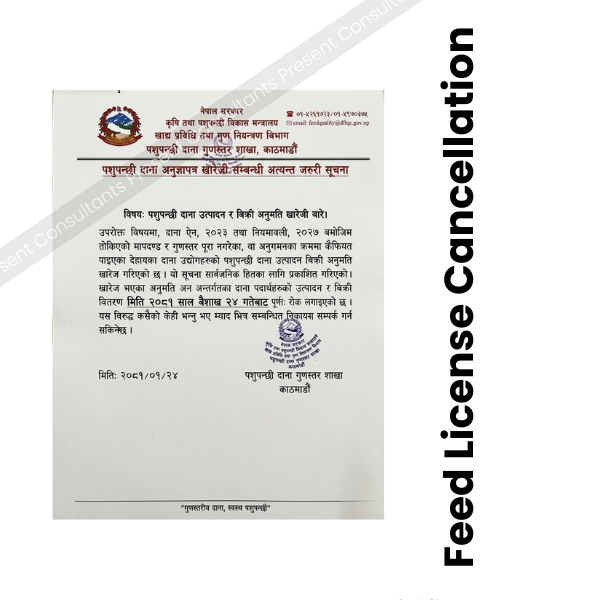
Feed License Cancellation (दाना अनुज्ञापत्र खारेजी)

In Nepal, the production, sale, and distribution of animal feed are strictly regulated to ensure the safety of the livestock value chain. When a feed mill, processing unit, or distribution hub decides to cease operations, Feed License Cancellation is a mandatory legal procedure. Formally closing a license with the Department of Food Technology and Quality Control (DFTQC) is essential to terminate your legal responsibility for feed quality and to avoid the ongoing accrual of renewal fees and administrative penalties. 

 150,000.00

Introduction: Feed License and Business Closure

Under the Feed Act, 2033 animal feed is treated with the level of scrutiny as human food. Maintaining an “Active” status on the NeFFILS (Nepal Food/Feed Information and Licensing System) portal means your business remains subject to surprise inspections and quality sampling. A formal closure ensures that your industry is legally de-listed, protecting the proprietors from liability if the brand name or premises are misused by third parties after the business has shut down. 

Legal Requirements and Consequences

In accordance with the Feed Act, 2033 and its associated Feed Rules, 2041, any licensed feed producer intending to close their business must submit a formal application for license revocation to the DFTQC or its designated Division Offices. This requirement involves the submission of a board resolution (for companies) or a formal declaration of closure, a “No Objection Certificate” (NOC) from the local Ward Office, and the physical return of the Original Feed Production License. Furthermore, as part of the closure audit, the operator must provide proof that any hazardous additives, growth promoters, or raw materials (such as contaminated grains) have been disposed of according to national environmental standards to prevent them from entering the local ecosystem. 

The consequences of failing to formally cancel a feed license are significant under the current regulatory enforcement. Under the Feed Act, 2033, continuing to hold an active license while the facility is substandard or “ghost-operating” can lead to fines and the confiscation of materials. More severely, if a business fails to formally de-register and is later linked to the distribution of “Substandard Feed” (which leads to livestock death or contaminated meat/milk), the proprietors face imprisonment for up to one year or heavy financial penalties. Additionally, the DFTQC maintains a registry of non-compliant operators, and failing to close a license properly can lead to a permanent bar on the directors from obtaining future feed or food-related industrial licenses in Nepal.

Process of Feed License Cancellation

Digital/Physical Application
File a request for cancellation through the NeFFILS portal or at the relevant DFTQC office, providing the specific date of operational shutdown.
Premises Inspection
A technical officer may visit the site to verify that feed production has ceased and that no “Restricted Additives” or mislabeled feed bags remain in stock.
Revenue Clearance
All outstanding annual license fees and any pending fines related to previous feed sample failures must be settled in full.
Final Revocation
Once the DFTQC is satisfied with the compliance report, a formal Revocation Order is issued, and the business is officially removed from the national feed producers’ directory.
Closing Your Feed Industry?
Managing the transition from an active feed mill to a legally closed entity requires careful coordination with the DFTQC and local authorities. Present Consultants Private Limited specializes in managing these technical filings, ensuring your original licenses are surrendered correctly and your board members are shielded from future livestock-related legal claims.

Related Services