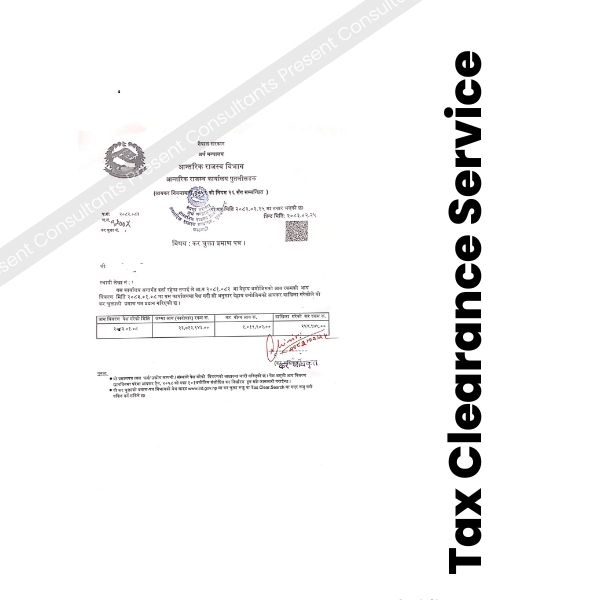
Secure your official Tax Clearance Certificate (कर चुक्ता प्रमाणपत्र) seamlessly with Present Consultants Private Limited. As a premier business consultancy Kathmandu trusts, we handle statutory financial closures, reconciliations, and compliance filings, keeping your organization structurally aligned with Tax Compliance Nepal protocols.
₨ 10,000.00
A Tax Clearance Certificate (कर चुक्ता प्रमाणपत्र) serves as absolute statutory proof issued by the Inland Revenue Department (IRD) confirming that a taxpayer has fully settled all financial and structural liabilities up to a specific date. Procedurally, obtaining tax clearance requires a systemic audit of ledger filings, reconciliation of advance tax deposits, and formal verification by the assigned Inland Revenue Office (IRO). For legal entities, updating structural data—including executing the necessary administrative adjustments for a formal name change—serves as a mandatory prerequisite to finalize corporate tax clearance assessments under integrated tax system guidelines.
Pursuant to Rule 26 of the Income Tax Rules, 2059, taxpayers must formalize an application for tax clearance alongside their final accounts under Section 96(2) of the Income Tax Act, 2058. Under Rule 24(1) of the Income Tax Rules, 2059, any person or entity registered for a Permanent Account Number (PAN) must formally notify the Department within fifteen (15) days of any structural alteration, such as an official name change, while annual returns must strictly adhere to the timelines defined under Section 96(1).
Failing to maintain active compliance triggers immediate statutory liabilities under Chapter 22 of the Act. Under Section 117(1)(a), non-filing of required returns incurs an immediate fine of NPR 5,000 per income year (or 0.1% of gross income, whichever is higher). Outstanding tax liabilities accumulate interest at a mandatory rate of 15% per annum under Section 119. Furthermore, failing to maintain or produce accurate corporate documents under Section 117(1)(b) attracts a penalty of 1.5% of gross turnover or NPR 1,000, whichever is higher, while continued defaults empower tax administrators to initiate asset recovery, account closures, or blacklisting under Section 104.