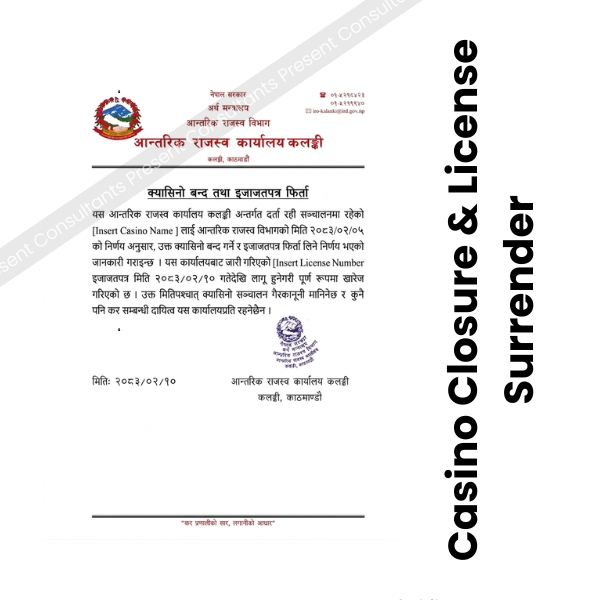
Closing a casino in Nepal is a regulatory process that goes far beyond simply locking the doors. Because casinos operate under a heavy tax and royalty regime, a “silent closure” can lead to massive personal liability for directors and investors. Casino Closure involves the formal surrender of the operating license to the Ministry, the final settlement of all labor and royalty dues, and a physical audit of gaming equipment to ensure a clean exit from the tourism sector.
₨ 100,000.00
Under the Casino Regulation, 2082, a casino license is a privilege tied to strict financial and security conditions. When an operator decides to cease functions—whether due to business restructuring, hotel contract termination, or financial shifts—they must initiate a formal “License Surrender” process. This ensures that the Department of Tourism (DoT) and the Ministry of Culture, Tourism and Civil Aviation (MoCTCA) officially record the cessation of the business, halting the accrual of daily royalty penalties and releasing the operator from continuous security monitoring requirements.
According to Rule 9(3) of the Casino Regulation, 2082, a casino license holder can submit an application for the closure of the casino to the Department of Tourism. If the licensee has paid all of the remaining arrears, like royalty, payment, renewal fines/dues, and all other fines/payments owed to the government, then the department can cancel the license for the operation of the casino.
Neglecting a formal surrender may be financially catastrophic. Even if the casino is inactive, royalties continue to accrue indefinitely as the business is still liable to fulfil its obligation. Furthermore, according to rule 26 of the regulation, if the license of operation of a casino is revoked by the government for not following the regulations, the government can blacklist investors. Thus, it is necessary to formally close the casino.